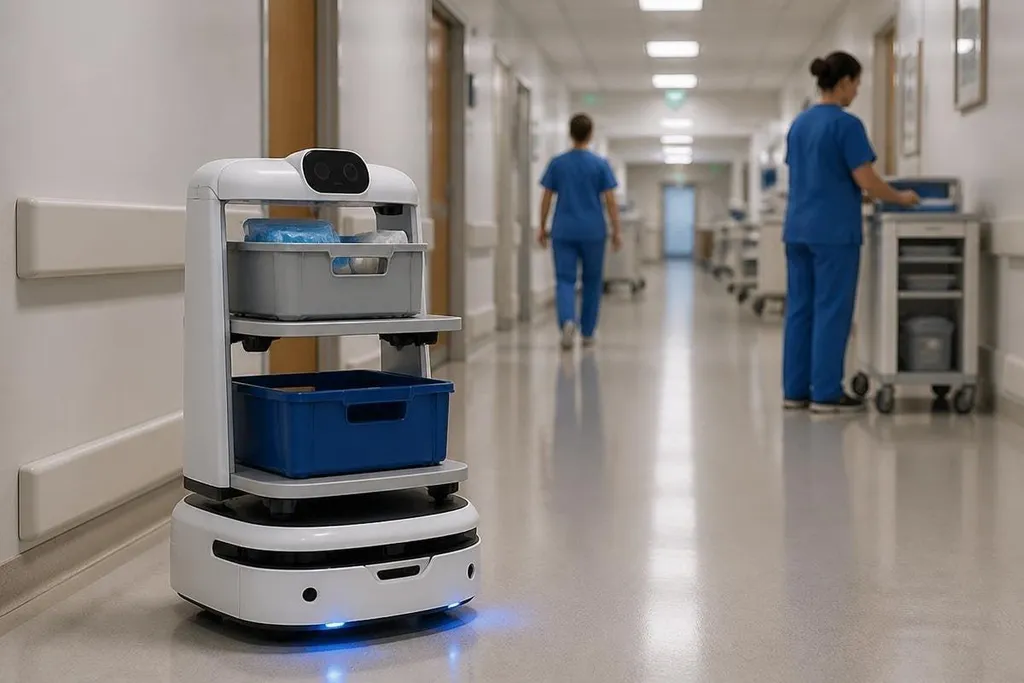
Healthcare robots are likely to spread through tasks with clear steps, fixed spaces, and measurable results. The first question for a hospital manager won't be whether a robot looks human. It will be whether the machine can do one job safely for a full shift.
- Robots will support staff before they replace staff.
- Transport, cleaning, surgery, and rehabilitation need different machines.
- Safety checks, training, and repair plans will matter as much as the robot.
Where robots fit first
Hospitals already contain many repeated movements. A robot can carry supplies between set points, move used equipment, or help staff lift a patient. These jobs take time from nurses and support teams, yet they don't require a machine to make a medical judgment.
The same rule applies in pharmacies and laboratories. A system can sort containers, move samples, or bring items to a work area when the route and handoff are controlled. The robot still needs sensors, software, and a way for a person to stop it when conditions change.
Surgical robots sit in a different group. They don't make the operation plan on their own. A surgeon controls the instruments, while the robot filters hand movement and positions tools inside the patient. That keeps the human decision at the center, even when the hardware adds steadier motion.
Why the hospital is a hard place to automate
A warehouse gives a robot marked routes and repeatable loads. A hospital gives it beds, people, loose cables, doors, spills, visitors, and urgent changes.
A machine that works in a test room may need new software and new safety rules before it can move near patients.
Privacy adds another limit. Cameras and microphones can collect health information, so the hospital needs rules for storage, access, and deletion. A useful robot must fit those rules without slowing care teams down.
The handoff matters too. If a robot leaves a tray in the wrong room, a person still has to find it. Small errors can erase the time saved by automation, so hospitals will need clear paths for reporting faults and checking results.
The human part stays in the loop
Robots can carry, scan, lift, guide, and repeat. They can't replace the judgment that comes from a patient's symptoms, history, or changing condition. That division will shape the next wave of healthcare automation.
A rehabilitation robot may guide a patient's leg through a set motion. A clinician still chooses the exercise, watches for pain, and changes the plan. An assistive arm may help someone reach a cup, while a therapist checks whether the movement supports the person's actual goal.
This is why training will take time. Staff need to know what the robot can do, where it can fail, and how to stop the task. Patients also need a clear explanation of what the machine does with their data and when a person takes control.
For hospital buyers, healthcare robotics reporting from Robot24.com can tie a machine’s task to its trial site, staff role, price, and safety record before the next section checks what to ask.
What buyers should check
A hospital team comparing a robot should start with the work, not the product video. This checklist keeps the decision tied to patient care and daily operations:
- Name one task: Write down the exact movement, handoff, or support job the robot must complete.
- Set a human stop: Confirm who can pause the robot and how fast the task ends.
- Check the setting: Test doors, lifts, floor surfaces, people, cables, and the traffic around the work area.
- Measure the handoff: Record what staff must do before and after the robot finishes.
- Plan repair work: Ask who fixes the machine, how parts arrive, and what happens during downtime.
- Review the data: Confirm what the robot records, where that data stays, and who can see it.
The strongest healthcare robots will probably be quiet systems that remove repeated work without hiding their limits. I'd skip any purchase built around a broad promise when the supplier can't name the task, the stop procedure, and the result that will be measured.
The next useful proof will come from routine use: a robot completing a defined hospital job, with staff time, errors, safety stops, and patient effects recorded over weeks rather than shown in a short demo.